

Table of Contents
Why 2025 Feels Different
SEO for 2025 is not an incremental shift, it is a change in what discovery looks like. Search is becoming a conversation, not a directory. Generative search and AI Overviews synthesize answers from multiple sources, and answer engines such as ChatGPT and Perplexity are now legitimate first stops for many users. The consequence is obvious, but easy to miss, which is that creators must compete for citations and trust as much as rankings.
The numbers tell the story. ChatGPT ranks as the world’s 5th most visited site, pulling nearly 5 billion visits monthly. Google’s AI Overviews now appear in approximately 47% of search results, and 58% of informational queries trigger these AI-generated summaries. Meanwhile, organic click-through rates drop by nearly 4x when AI Overviews appear. This is not a temporary disruption. This is the new baseline.
What makes 2025 different is not just the technology, but the speed of adoption. In 2023, approximately 13 million American adults used AI for search. That number is expected to reach 90 million by 2027. Generative AI search is most popular among Gen Z, who perform up to 31% of their searches on AI platforms like ChatGPT. The behavior is spreading upward through demographics, and the platforms are multiplying. Search is not dying. It is fracturing across Google, LLMs, social platforms, and forums, and creators who understand this will build presence where others lose it.
What Creators Must Stop Doing
If you still measure success only by raw organic sessions, stop. If your content strategy says publish long pillars and hope for clicks, stop. If your only brand-building action is buying backlinks, stop. Those tactics worked when the web was a stack of pages people navigated to, not an ecosystem of synthesized answers and social-first discovery.
The old playbook assumed that ranking in position one or two guaranteed traffic. That assumption is breaking. AI Overviews have reduced organic web traffic by 15% to 25% across many sites, even as impressions and visibility metrics climb. This phenomenon, often called “The Great Decoupling,” means you can rank well and still see fewer visitors. The SERP itself is no longer a reliable conversion funnel when answers appear before links.
Stop chasing vanity metrics. Stop assuming that more content equals more results. Stop ignoring the platforms where your audience actually starts their research. The web is not a single search box anymore, and your strategy cannot be either.
What Creators Should Start Doing
Think of your work as a network of provable answers. The objective is not only to rank, it is to become the source an AI will cite. That means three changes. First, emphasize original reporting or experience. Second, make answers extractable, with clear headings and short summary blocks. Third, distribute across platforms so an answer engine finds multiple signals linking back to you.
The shift from traffic to trust is not optional. 84% of marketers believe in using AI for SEO by aligning web content with users’ search intent, and 82% of consumers find AI-powered search more helpful than traditional SERPs. If your content does not satisfy intent in a way that machines can parse and humans can trust, you will not appear in either traditional results or generative answers.
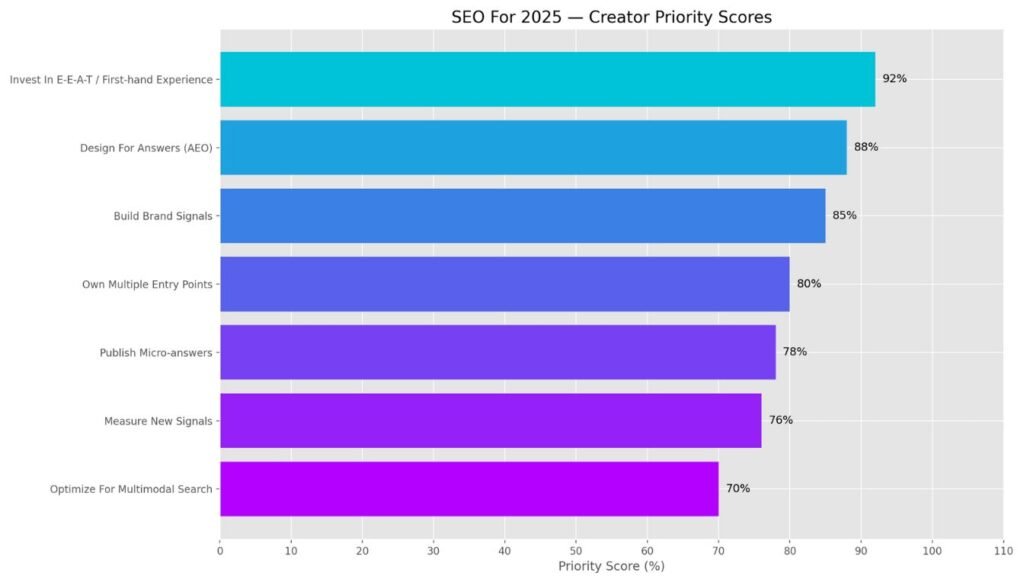
1. Design For Answers, Not For Ranks
Answer Engine Optimization, or AEO, is the practical skill you need. AI Overviews like Google’s tend to cite content that is concise, clearly structured, and sourced. Put a 40 to 80 word answer box at the top of articles, use question headings, and include numbered steps or bullet lists for how-to content. Use Article and FAQ schema so machines can parse and trust your structure. This approach helps in both traditional SERPs and generative search.
The technical foundation matters more than ever. Structured data markup helps search engines understand content better and can improve presence in featured snippets. Schema is not a nice-to-have. It is the language that AI uses to understand your content’s context, relationships, and authority. If your pages lack structured data, you are invisible to the systems that power generative answers.
Think about how your content appears when extracted. AI systems do not read your entire article. They scan for patterns, pull key sentences, and reconstruct answers from fragments. If your key points are buried in long paragraphs or hidden behind vague subheadings, they will not be extracted. Make your answers obvious. Make them portable. Make them citeable.
2. Invest In First-Hand Experience And E-E-A-T
Experience, expertise, authoritativeness and trustworthiness are no longer optional signals. I learned this when a short case study I wrote about email onboarding began to be quoted in AI answers more than a longer roundup I published. First-hand data, named authors with bios and credentials, and clear sourcing convert into citations. That payoff looks different from old traffic metrics: fewer vanity visits, more qualified readers.
Google’s E-E-A-T framework is the foundation of modern SEO for 2025. The first E, Experience, is the newest addition and the most important. AI systems are designed to prioritize content that demonstrates real-world experience, not just keyword optimization. This means case studies, original research, named authors with verifiable credentials, and transparent sourcing.
The data supports this. Websites using AI-generated content grew 5% faster than others, but human-written sites were 4% less likely to face Google penalties. The sweet spot is using AI for efficiency while maintaining the authenticity and expertise that only humans can provide. AI can help you scale, but it cannot replace the unique perspective that comes from doing the work.
Original research is your competitive advantage. First-party research citations and expert quotes in trade publications signal authority to both traditional search engines and LLMs. When you publish data that no one else has, you become the source that AI must cite. That is the goal.
3. Own Multiple Entry Points
Search now spans Google, LLMs, social platforms, and forums. Publish short explainer videos, tweet-sized takeaways, a Reddit post answering a specific question and a canonical article on your site. When multiple platforms point to the same fact, LLMs and AI Overviews are likelier to surface your content as a source. Your goal is to be discoverable wherever people start looking for answers.
The fragmentation of search is not a problem. It is an opportunity. Search is not a platform, it is a behavior, and that behavior is now distributed across multiple channels. Your content strategy must reflect this reality. A single blog post is not enough. You need a content ecosystem that reinforces your authority across platforms.
Think about the user journey. Someone might first encounter your brand through a TikTok video, then search for more information on Google, then ask ChatGPT for a summary, then visit your site for the full story. Each touchpoint needs to be optimized for its platform while maintaining a consistent message. This is not about duplicating content. It is about adapting your core insights to fit the format and audience of each channel.
4. Measure The New Signals
Clicks and impressions matter, but so do branded search growth, direct visits, referral spikes, and mentions within communities. AI-driven features may not send predictable referrers. Track citations in answer engines where possible. Use signal combinations: if branded queries rise while organic clicks dip, you might be winning trust even as visibility changes.
The metrics that mattered in 2020 are not the metrics that matter in 2025. Only 22% of marketers track LLM brand visibility or traffic, but 53% say they are in the early stages of exploring how to monitor this emerging channel. The gap between awareness and action is your opportunity.
Start tracking branded search volume. If people are searching for your brand by name, it means they encountered you somewhere else and want to learn more. That is a signal of trust. Track direct traffic. If people are typing your URL directly into their browser, it means they remember you. Track referral traffic from AI platforms when possible. Some answer engines are starting to provide referrer data, and that data is gold.
Most importantly, track conversions, not just traffic. The shift from traffic to conversion quality is the defining trend of SEO for 2025. You may get fewer visitors, but if those visitors are more qualified and more likely to convert, your business outcomes improve. That is the trade-off, and it is worth managing.
5. Build Brand Signals Intentionally
A recognizable brand functions as credibility in a world of synthesized answers. Earn mentions on reputable publications, maintain up-to-date author pages, gather genuine reviews and cultivate social proof. Those pieces of reputation data are the threads AI follows back to a source when it constructs an answer.
Media mentions across trusted publications are the foundation of entity authority. When your brand is mentioned in the New York Times, CNBC, or industry-specific trade publications, AI systems take notice. These mentions signal that your brand is authoritative, trustworthy, and worth citing.
Author pages are underutilized. Every piece of content should have a named author with a bio, credentials, and links to their other work. This signals expertise to both humans and machines. Reviews and testimonials matter. They provide social proof that your brand delivers on its promises. Cultivate them intentionally, and display them prominently.
6. Optimize For Multimodal Search
Visual search and short-form video matter. Provide high-quality images with descriptive alt text and captions that include your primary phrase when relevant. Publish clipped explainer videos with timestamps and transcripts so AI can index your multimedia content. Multimodal assets increase the chance of being included in an overview that blends text, images and video.
Video content is exploding as a search format. Google’s AI Mode and other answer engines are increasingly incorporating video results alongside text. If your content strategy does not include video, you are missing a major visibility opportunity.
The good news is that video does not have to be expensive or time-consuming. Short explainer videos, screen recordings, and talking-head clips all work. The key is to make them searchable. Use descriptive titles, add timestamps, include transcripts, and optimize your video descriptions with relevant keywords. AI systems can index video content, but only if you give them the metadata they need.
A Short Checklist You Can Use This Week
- Add a concise answer block at the top of key posts.
- Add Article and FAQ JSON-LD to priority pages.
- Publish one original data point or case study this quarter.
- Convert one long post into three interlinked micro-answers.
- Post two community answers where your audience hangs out.
- Audit and complete author bios and source lists.
An Anecdote About Changing Course
When I split a long guide about onboarding into a few focused question-and-answer pages, something surprising happened. The site’s total visits dipped slightly, but conversions rose and the pages started showing up in chat answers and referral snippets. The lesson I keep telling teams is simple. Visibility may shrink in one metric, but depth and trust often improve elsewhere. That trade-off is worth managing.
This is the reality of SEO for 2025. You may see fewer clicks, but the clicks you do get are more valuable. You may rank for fewer keywords, but the keywords you rank for drive more conversions. You may appear in fewer traditional search results, but you appear in more AI-generated answers. The game has changed, and the winners are the ones who adapt.
Final Thought: Play The Long Game
SEO for 2025 rewards creators who act like reporters and librarians at once. Report original things, make facts easily extractable, and create reputational signals that travel beyond a single search engine. Short term, you may lose some familiar metrics. Long term, you build presence across a richer ecology of discovery. That durability is what will matter.
The brands that thrive in 2025 and beyond will be the ones that embrace change, invest in quality, and build authority across multiple platforms. They will be the ones that understand that SEO for 2025 is not about gaming algorithms. It is about becoming the source that AI systems trust and cite. That is the future, and it is already here.