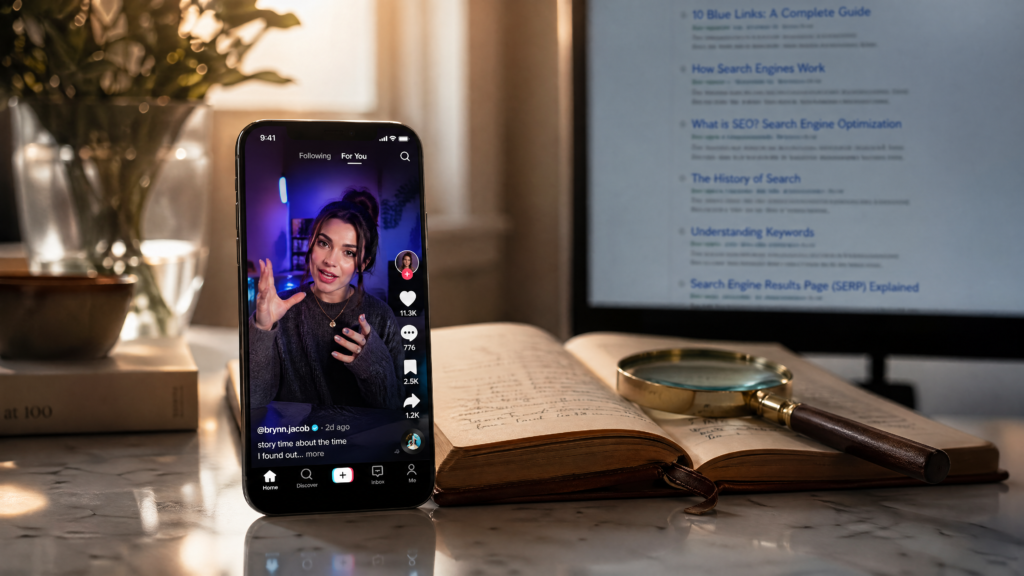
There’s a moment every marketer reaches when they finally acknowledge the obvious: nobody’s using Google to find restaurants anymore. Or products. Or answers. They’re using TikTok.
I first noticed this shift about six months ago when I watched a 19-year-old search for “best air purifier” on TikTok instead of Google. Not because she didn’t know Google existed. Because she wanted to see real people unboxing the product in their actual homes, warts and all. She wanted authenticity over algorithmic rankings. That single moment crystallized something that the data has been screaming for months: the internet has undergone a fundamental reorganization, and most content creators and marketers haven’t caught up yet.
The numbers tell the story clearly. According to new research from Sprout Social, 60 percent of consumers now use Instagram as a discovery tool for products and services. 54.5 percent turn to TikTok. By comparison, only about 40 percent start with a traditional search engine. YouTube Shorts alone is projected to surpass 70 billion daily views this year. We’re not talking about a niche phenomenon anymore. Social platforms have become the primary search engine for an entire generation.
This isn’t just a consumer behavior shift. It’s a complete inversion of how the internet was supposed to work.
The Death of Keyword-Driven Search
For twenty years, the fundamental question for any content creator was simple: how do I rank for this keyword? If you could get on page one of Google for “how to start a podcast,” you won the game. Millions of people would flow through your funnel. Businesses built empires on this principle.
That world is ending. Not because Google is disappearing, but because people have stopped using search the way they used to. They don’t want to type in a query and get ten blue links anymore. They want immersive video, human storytelling, and real people sharing real experiences.
When someone wants to learn about video editing software, they don’t search “best video editing tools.” They search for “video editing software review TikTok” or they just browse their For You page until someone’s editing demo catches their eye. The algorithm does the heavy lifting now. You don’t go searching for content on social media; the platform brings content to you based on your interests and behavior.
This changes everything about how content should be created and distributed. The old playbook of “create comprehensive guides optimized for long-tail keywords” still has value, but it’s no longer the primary way most people discover information. Instead, the creators winning right now are the ones who understand short-form video format, who know how to hook attention in the first three seconds, and who are building genuine community rather than just chasing views.
What Marketers Are Getting Wrong
Here’s what strikes me about the current moment: most established brands and creators are operating with a split strategy. They still invest heavily in traditional search optimization while halfheartedly dabbling in social content. That’s backwards. The data suggests social platforms should now be the center of your discovery strategy.
Consider who’s actually winning in this environment. It’s not the brands creating perfectly polished ads. It’s creators who show the messy reality of using a product. A founder making jokes about their failed product launch gets more engagement than a professional commercial. A designer showing their iteration process, including failed attempts, gets more follows than someone posting finished work.
The shift toward authenticity over polish is so pronounced that TikTok and Instagram increasingly reward raw, unfiltered content. Your phone videos perform better than your studio productions. Your honest takes beat your corporate messaging. This runs counter to everything the marketing establishment learned in the past decade.
Why does this matter? Because social search is discovery driven by human curation and algorithm optimization, not keyword optimization. You can’t “hack” your way to the top anymore by keyword density and backlinks. You have to actually understand what makes content worth watching.
The Creator Economy Acceleration
What makes this moment particularly interesting is that it’s happening simultaneously with another shift: the creator economy is booming. We’re now looking at a global market exceeding 250 billion dollars. Major brands aren’t just marketing on social platforms; they’re outsourcing entire content operations to individual creators.
Seventy percent of consumers report looking for user-generated content before making a purchase decision. That’s double the number from last year. Think about that. More people are influenced by random TikToks from strangers than by official brand marketing.
At the same time, artificial intelligence is transforming what it means to be a “creator.” Tools like Google Veo 3.1 Lite can now generate production-quality video at a fraction of the cost and time of traditional production. Uizard and Relume can turn text prompts into complete website designs. The barrier to entry for content creation has collapsed.
This creates a strange paradox: the creator economy is worth more money than ever, but the tools to participate are more accessible than ever. Which means that individual creators with strong voices and authentic perspectives now have more leverage than established media companies with bigger budgets.
I watched a creator with three hundred thousand followers on TikTok turn down a brand deal with a major retailer because the terms didn’t align with her values. Five years ago, that would have been unthinkable. Now, creators have real bargaining power because there’s genuine scarcity: authentic, human connection at scale.
How to Adapt Your Strategy
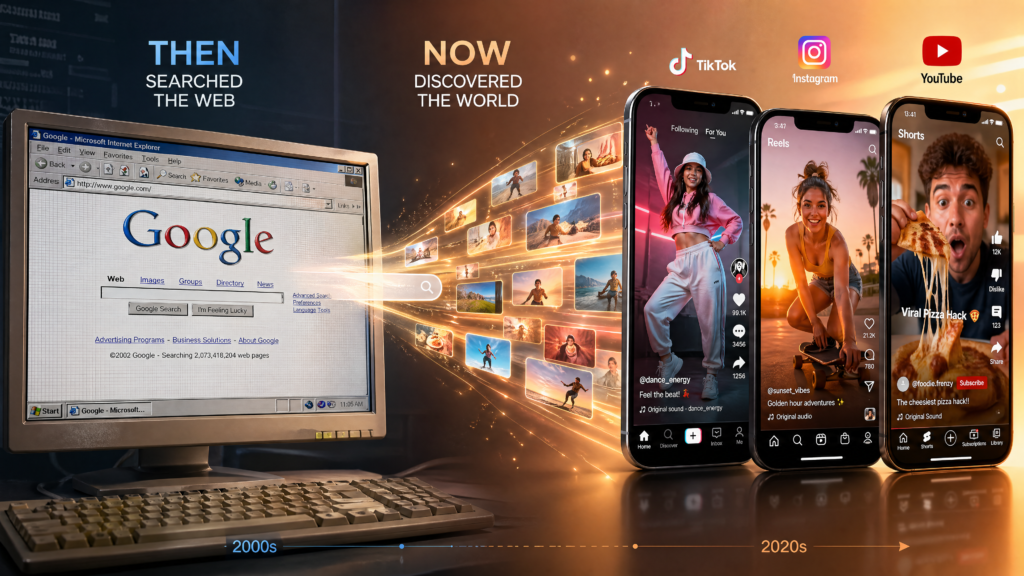
If social platforms are now the primary search engine, then your content strategy needs to reflect that reality. This means a few concrete shifts.
First, prioritize short-form video. Not as an afterthought or a “we should probably have a TikTok.” As a core part of your distribution. YouTube Shorts, Instagram Reels, and TikTok videos aren’t side channels; they’re the main channel now.
Second, optimize for the social search algorithm, not the Google algorithm. This means understanding what hooks people in the first second. It means knowing your niche’s community inside these platforms. It means engaging directly with audiences through comments and conversations. The algorithm rewards this behavior. Traditional SEO doesn’t.
Third, lean into authenticity. The data couldn’t be clearer: people trust real people. User-generated content consistently outperforms brand content by 8 to 10 times in engagement. If you’re a founder or creator, your personal brand is now your most valuable asset. Share your process. Talk about what doesn’t work. Let people see the human behind the business.
Fourth, build community, not just audience. The creator economy trend this year is distinctly moving away from chasing viral moments toward building loyal communities. Platforms like Discord and Substack are thriving because they create spaces for sustained engagement rather than one-off viral hits. Think about how you can deepen relationships with your existing audience rather than always chasing new followers.
Finally, don’t abandon traditional search entirely, but reframe how you use it. Long-form content on your website or YouTube channel can still drive significant value. But the funnel has inverted. Social discovery comes first. Your long-form content comes second, supporting and deepening what social initially sparked.
The Bigger Picture
What’s really happening here is that people have decided they’d rather be discovered by algorithms trained on human behavior than by algorithms trained on links and keywords. That’s a more natural model for how discovery actually works in a social world. You find things because your friends found them, or because you see them being talked about in communities you care about, or because an algorithm noticed you engaged with similar content.
This represents a permanent shift in how information moves through networks. Content creators and marketers who understand this early will have a significant advantage. They’ll know that the boring, behind-the-scenes reality often beats the polished pitch. They’ll understand that community matters more than follower count. They’ll recognize that authenticity is now a competitive advantage rather than a liability.
The search engine of the internet didn’t disappear. It just moved. And it now lives in your TikTok For You page.