
Table of Contents
Something happened in the third week of April 2026 that the creative industry will be talking about for years. Within 48 hours of each other, Canva and Adobe, the two companies that essentially own the design software market, both unveiled AI systems that don’t just assist with creative work. They do the work.
Canva called it Canva AI 2.0. Adobe called it the Firefly AI Assistant. The branding differs, but the underlying proposition is identical: tell the software what you want, and it figures out how to make it. Not by offering you a template. Not by suggesting a font. By actually orchestrating a sequence of design decisions across multiple tools, producing something finished, or very close to it, on the other end.
This is not an incremental upgrade. This is the moment AI design agents moved from research demos to shipping products. And if you create content, build websites, or run any kind of digital business, the implications are worth sitting with.
What “Agentic” Actually Means (and Why It Matters)
The word “agentic” has been floating around the AI world for over a year, but it just became concrete. In design terms, here’s the distinction that matters.
Traditional AI design tools work like autocomplete. You start a project, and the software offers suggestions: layout options, color palettes, image recommendations. You’re still the one clicking, dragging, and deciding. The AI is reactive.
An agentic AI design tool works more like a junior designer you just hired. You hand it a brief. Maybe you describe what you need in plain English: “Create a social media campaign for a coffee brand launch, warm tones, modern typography, sized for Instagram Stories and LinkedIn posts.” Maybe you upload a sketch on a napkin. Maybe you paste in a competitor’s landing page and say, “Something like this, but for our brand.”
Then the agent goes to work. It selects the right tools within the platform, generates layouts using editable objects (not flat images), applies brand guidelines it has learned from your previous projects, and delivers a set of options. You refine from there.
Canva’s version of this, launched at their Create 2026 event in Los Angeles on April 16, introduces what they call “agentic orchestration.” The system has access to Canva’s complete design engine and can coordinate across presentations, social posts, documents, and even data visualizations in a single workflow. Everything it generates uses layered, editable objects. You can swap a headline without rebuilding the layout.
Adobe’s Firefly AI Assistant, announced the same week, takes a similar approach but across the Creative Cloud ecosystem. You can describe a multi-step task in conversation, and the assistant executes it across Photoshop, Premiere, Illustrator, and Lightroom. It also includes a library of “Creative Skills,” which are pre-built workflows you can customize or build from scratch.
The Week That Changed the Creative Stack
I’ve been covering AI tools for content creators for a while now, and I can’t recall a week quite like this one. It wasn’t just Canva and Adobe. Anthropic’s Claude Design demonstrated it could generate an Uber brand video with motion graphics in under four minutes. It recreated a landing page from a screenshot. These aren’t party tricks anymore. They’re workflows.
What made this week feel different is the convergence. When one company ships an agentic design tool, it’s a product launch. When three ship in the same window, it’s an industry agreeing on where things are headed.
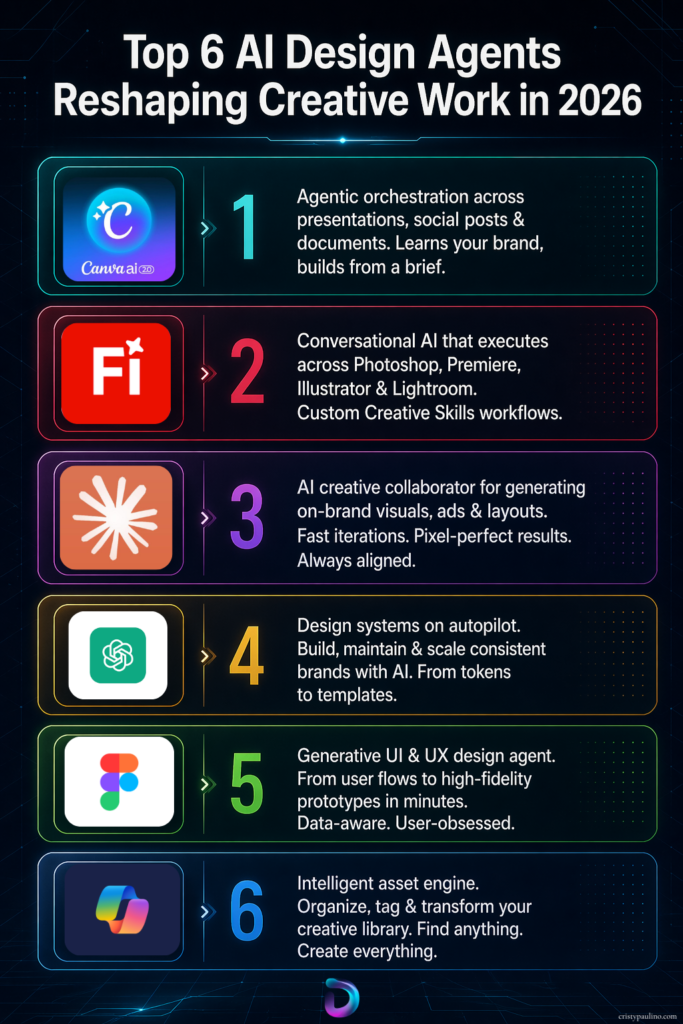
Here’s a snapshot of the six AI design agents leading the shift in 2026 — each approaching creative automation from a different angle, but all moving toward the same destination: software that doesn’t just assist your work, it does the work.
And the data supports the urgency. According to a 2026 study by web hosting provider 20i, 76% of web design professionals now identify AI as the primary threat to their business. That’s not “AI might eventually be a concern.” That’s three out of four designers saying the thing that keeps them up at night isn’t losing clients to a cheaper freelancer. It’s losing clients to software.
On the other side of that equation, 84% of professional developers report they’ve already integrated AI into their daily workflows. Many say AI now generates or assists with up to 90% of their code. The adoption isn’t coming. It’s here.
Why This Is an Evergreen Shift, Not a News Cycle
It’s tempting to treat these launches as just another round of tech announcements. New features, new buzzwords, new demos. But I think there’s something structurally different about the move to agentic design, and it has to do with who these tools are actually for.
For the past decade, the design software market has operated on a clear hierarchy. Professional tools (Adobe’s suite) sat at the top, requiring significant skill and training. Accessible tools (Canva, Figma) sat in the middle, lowering the barrier with templates and drag-and-drop interfaces. And below that, you had basic editors and free tools.
AI design agents collapse this hierarchy. When the interface is a conversation, the gap between a trained designer and a small business owner writing a prompt shrinks dramatically. Not to zero. Taste, strategy, and brand thinking still matter enormously. But the mechanical execution gap, the part that used to take hours of Photoshop work, is disappearing.
This is why Canva’s pivot is so telling. The company built a $40 billion business on making design accessible through templates. Now they’re saying templates aren’t enough. The future, as they see it, is a system that understands your intent and builds the design from scratch, customized to your brief, your brand, and your audience.
What This Means for Content Creators and Web Designers
If you’re a content creator or someone who builds websites for clients, here’s the honest assessment.
The floor is rising. The minimum viable quality for marketing materials, social content, and web design is about to jump significantly. A solopreneur with a Canva subscription can now produce work that would have required a small agency team two years ago. That’s both an opportunity and a competitive pressure, depending on where you sit.
For creators who already work with these tools, the leverage is extraordinary. A few specific implications worth noting:
Content production speed is about to multiply. If you’re producing social media assets, blog graphics, or presentation decks, agentic tools can handle the first draft in minutes. Your job shifts from production to creative direction and refinement.
Brand consistency gets easier to maintain. Both Canva AI 2.0 and Adobe’s system can learn and apply brand guidelines automatically. For anyone managing content across multiple channels, this solves one of the most persistent headaches in digital marketing.
The value of strategic thinking increases. When execution becomes cheap and fast, the premium moves upstream. Understanding your audience, crafting a narrative, knowing what to say and why: these skills become more valuable, not less, in an agentic AI world.
Web designers who position themselves as strategists rather than pixel-pushers will thrive. Those who sell execution alone face real pressure.
The Integration Play Nobody Is Talking About Enough
Here’s the detail from the Canva AI 2.0 launch that I think deserves more attention. The system doesn’t just connect to Canva’s own tools. It integrates with Slack, Gmail, Google Drive, and Zoom. You can, for example, feed it a recorded Zoom meeting transcript and have it produce a structured report with designed slides.
This matters because it signals that AI design agents aren’t trying to be standalone tools. They’re trying to be the connective tissue of your entire workflow. The design layer that sits on top of your communication, your data, and your content, pulling from all of it to produce finished work.
Adobe is moving in the same direction with its NVIDIA collaboration, announced April 20, featuring AI agents that automate content creation, editing, and decision-making for enterprise teams.
ChatGPT is doing something parallel with its “super app” strategy, embedding brands like Canva, Spotify, and Target directly inside conversations. OpenAI earned $1 million in ad revenue from 600 advertisers in just six weeks, with ads shown to only 20% of eligible users. The creative workspace and the AI assistant are merging.
How to Prepare (Without Panicking)
The shift to AI design agents doesn’t mean designers and creators become irrelevant. It means the job description changes. Here’s what’s worth doing now.
Learn the tools before they learn your job. Canva AI 2.0 is rolling out to its first million users now. Adobe’s Firefly AI Assistant enters public beta in the coming weeks. Get in early. The creators who understand how to direct these agents effectively will have a meaningful advantage over those who wait.
Invest in what AI can’t replicate. Original photography, distinctive brand voice, authentic storytelling, deep audience understanding: these remain stubbornly human. The more commoditized AI makes basic design execution, the more valuable genuinely original creative thinking becomes.
Rethink your pricing model. If you’re a freelancer charging by the hour for design work, the math is about to change. Consider value-based pricing tied to outcomes (conversions, engagement, brand perception) rather than time spent in Photoshop.
Stay curious, but stay grounded. Not every AI feature will work as advertised on day one. These are version 1.0 products. But the direction is unmistakable. The creative tools we’ve known for two decades are becoming creative agents. The question isn’t whether this changes your work. It’s how quickly you adapt.